Faqs
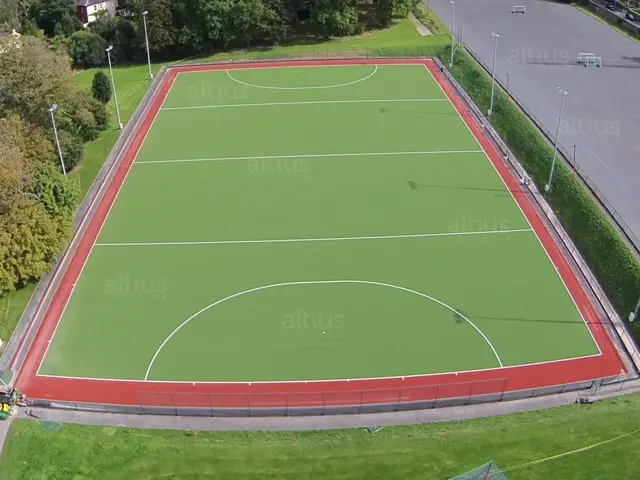
An international standard hockey field overall (usually) measures 101.4m x 65m in which the
playing area is 91.4m x 55m. However, you need a minimum of 3m run-off area behind the goal post
and 2m run-off area in the sidelines.
A global category hockey field can involves base works, sprinkler system, fencing as well
as the cast in situ shock pad and the hockey turf and accessories. In case of national category
hockey fields, you do not need the sprinkler system (or, for that matter, even the water storage
facility and another saving is that it can go down on a crushed rock base). The price for a
complete turnkey project would vary from Rupees 30 million to Rupees 60 million.
Yes, the run-off in hockey is mandatory, both for player safety and FIH certification. The
minimum behind the goal post is 3m and the minimum on the said lines is 2m.
There are usually different products for wet turf and different products for dry turf. One
uses water while the other is dressed with sand. However, there are products on where you can
water the turf and, at the same time, you can play on the turf dry to conserve water. Further,
even when playing dry on this particular surface, developed by TigerTurf, the warranty and
guarantee still remains much the same if you were playing on a wet surface. This product from
TigerTurf on which you can play both wet and dry is called TigerTurf Wett Pro where Wett stands
for water efficient TigerTurf.
The pads used underneath a hockey turf can be either pre-fabricated (i.e., pre made and
shipped in rolls and they simply need to be rolled out on the base) or cast in situ (i.e., the
shock pad is cast on site). A pre-fabricated/roll-out shock pad usually lasts up to 3 times the
life cycle of the hockey turf – which does result in substantial saving for the client.
Standard hockey turf is usually loose laid on the roll out or cast in situ shock pad. This
means that the hockey turf can blow up lightly, get wrinkled, owing to temperature extremes
especially when it is non-infill and loose laid. However, when you strip glue the hockey turf to
the pad underneath, it ensures that there is no movement of the hockey turf and regardless of
which direction you hit the ball in, it doesn’t bounce or skip owing to unevenness of the hockey
turf that has been simply laid on the shock pad. This bonding of the turf with the shock pad
also implies that the turf does not move under pressure of the athlete’s foot Strip gluing is a
technical process requiring expertise and machinery and available to companies like TigerTurf.
The most exciting and also the most technical part of the hockey field is when you have the
penalty corners taking place. Most companies cut the circle of the D into the turf, including
the straight of the D. Which means that the area of most critical use is not machine made but
relies on human expertise using tape and glue. However, TigerTurf is aware and conscious of the
rules of the game and believes in equal opportunity to both teams. Hence, they tuft the top of
the D while manufacturing the turf to ensure structural integrity, durability, consistency and
true play.
An international standard hockey field overall (usually) measures 101.4m x 65m in which the
playing area is 91.4m x 55m. However, you need a minimum of 3m run-off area behind the goal post
and 2m run-off area in the sidelines.
A global category hockey field can involves base works, sprinkler system, fencing as well
as the cast in situ shock pad and the hockey turf and accessories. In case of national category
hockey fields, you do not need the sprinkler system (or, for that matter, even the water storage
facility and another saving is that it can go down on a crushed rock base). The price for a
complete turnkey project would vary from Rupees 30 million to Rupees 60 million.
Yes, the run-off in hockey is mandatory, both for player safety and FIH certification. The
minimum behind the goal post is 3m and the minimum on the said lines is 2m.
There are usually different products for wet turf and different products for dry turf. One
uses water while the other is dressed with sand. However, there are products on where you can
water the turf and, at the same time, you can play on the turf dry to conserve water. Further,
even when playing dry on this particular surface, developed by TigerTurf, the warranty and
guarantee still remains much the same if you were playing on a wet surface. This product from
TigerTurf on which you can play both wet and dry is called TigerTurf Wett Pro where Wett stands
for water efficient TigerTurf.
The pads used underneath a hockey turf can be either pre-fabricated (i.e., pre made and
shipped in rolls and they simply need to be rolled out on the base) or cast in situ (i.e., the
shock pad is cast on site). A pre-fabricated/roll-out shock pad usually lasts up to 3 times the
life cycle of the hockey turf – which does result in substantial saving for the client.
Standard hockey turf is usually loose laid on the roll out or cast in situ shock pad. This
means that the hockey turf can blow up lightly, get wrinkled, owing to temperature extremes
especially when it is non-infill and loose laid. However, when you strip glue the hockey turf to
the pad underneath, it ensures that there is no movement of the hockey turf and regardless of
which direction you hit the ball in, it doesn’t bounce or skip owing to unevenness of the hockey
turf that has been simply laid on the shock pad. This bonding of the turf with the shock pad
also implies that the turf does not move under pressure of the athlete’s foot Strip gluing is a
technical process requiring expertise and machinery and available to companies like TigerTurf.
The most exciting and also the most technical part of the hockey field is when you have the
penalty corners taking place. Most companies cut the circle of the D into the turf, including
the straight of the D. Which means that the area of most critical use is not machine made but
relies on human expertise using tape and glue. However, TigerTurf is aware and conscious of the
rules of the game and believes in equal opportunity to both teams. Hence, they tuft the top of
the D while manufacturing the turf to ensure structural integrity, durability, consistency and
true play.
Testimonials

Ashok Rathore | Founder & Director - Oscar Foundation
Oscar Foundation is a football development non-profit organization dedicated to empowering children and youth in low-income communities in India.

TBC Park Aizawl, Mizoram
Set on a hilltop with a breath-taking view, this pay n play facility has encapsulated the interest of the people of Mizoram.

Tashi Namgyal Academy - Gangtok
Altius Sports designed synthetic turf surface for Tashi Namgyal Academy in Gangtok. The first in Sikkim to get the TigerTurf upgrade.